
Sei Psicoterapeuta e lavori in Italia?
È aperta la raccolta di manifestazioni di interesse per partecipare allo studio di ricerca promosso dall’Università degli Studi di Torino. AidedPsy è utilizzata esclusivamente a fini di ricerca, per valutare come strumenti di intelligenza artificiale possano supportare il terapeuta nell’osservazione e nella riflessione sul processo clinico.Five Fractures in a Trillion-Dollar Crisis
Roughly 970 million people lived with a mental disorder in 2019, with suicide claims nearly 800,000 lives annually, making it a top cause of death globally. By 2030, depression is projected to rank first for disease burden worldwide, reflecting the escalating economic toll exceeding $1 trillion yearly in lost output (WHO, 2025).
Psychotherapy is one of the most powerful tools we have to fight this crisis.
And yet, psychotherapy itself is broken in ways that most people, including most funders and policymakers, do not fully appreciate.
One in Five Patients Walks Away.
On average 20% of patients drop out of psychotherapy prematurely (Swift & Greenberg, 2012). For personality disorders, that percentage exceeds 37% (McMurran et al., 2010).
Therapists Cannot See What Is Happening in Their Own Sessions
Therapists frequently fail to detect therapeutic alliance ruptures as they occur (Safran & Muran, 2000; Eubanks et al., 2018). This is not a matter of incompetence, it is a structural limitation of human cognition.
Psychotherapy Generates Almost No Data About Itself
Modern medicine runs on data, from basic blood tests to most advanced diagnostic technologies. But psychotherapists often operate with virtually no objective, continuous measurement of what is happening in the treatment room. Session notes are subjective. Outcome measures, when collected at all, are sporadic and coarse.
There Is No Quality Assurance System for Psychotherapy
Perhaps the most fundamental problem: there is no guardrail. A therapist who gradually drifts away from effective protocols, a phenomenon extensively documented as “therapist drift” (Waller, 2009), has no system that detects and corrects the drift.
Your Outcome Depends on Your Therapist, Not Your Treatment
Meta-analyses across thousands of patients show that the individual therapist accounts up to 55% of the variance in patient outcomes (Baldwin & Imel, 2013; Crits-Christoph et al., 1991).
These five fractures are structural failures that cost trillions in economic productivity, millions of lives in avoidable suffering, and an immeasurable toll in human potential never realized.
They have persisted because, until now, no technology existed to address them simultaneously at the point of care.
That technology now exists.
AidedPsy uses data and AI to turn Psychotherapy into a Measurable Science.
What does AidedPsy do
The AidedPsy is a fundamentally new way of practicing, monitoring, and continuously improving psychotherapy: an AI-powered clinical intelligence system that works in real time, within every single session.
The PPI transforms psychotherapy from an unmonitored, unmeasured, and unreproducible craft into a transparent, data-driven, and continuously self-improving science.
PPI does not position itself as an oracle of truth and does not replace clinical judgment. Rather than prescribing solution or diagnoses, it enriches the therapist's thinking process, making the therapist's judgment infinitely better informed.
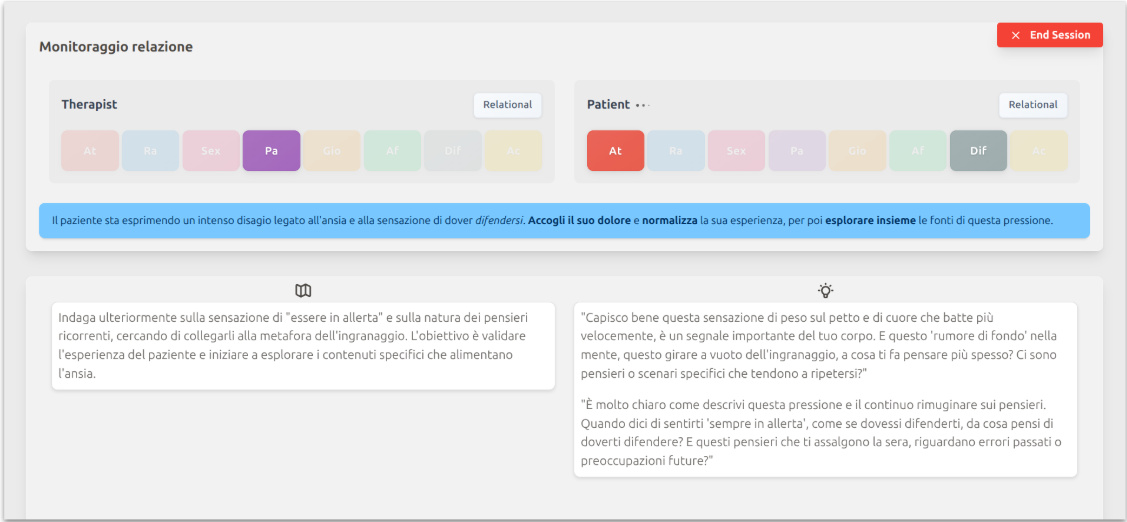
What PPI Does in Every Session

Captures and transcribes the entire session using speech recognition technologies, with speaker diarization, turn-taking analysis, speech speed and pause measurements.

Analyzes transcripts using deep NLP to extract psychopathological markers (rumination, cognitive distortions, avoidance language, dissociative markers), identify which therapeutic techniques were used, assess interaction quality, and track thematic evolution across the entire treatment history.

Monitors therapeutic alliance and detects alliance ruptures in real time, using computational implementations of scientifically-grounded cognitive and evolutionary theories. When detecting a misattunement between the therapist's relational stance and the patient's interpersonal needs, it generates a discreet alert.

Administers psychological assessments via Computerized Adaptive Testing (CAT), using Item Response Theory algorithms that dynamically select the most informative items, reducing test burden by 40–60% while maintaining full psychometric precision. The patient is continuously assessed without being overwhelmed.

Generates AI-powered strategic recommendations synthesizing all data streams (emotional, interpersonal, psychometric, linguistic, historical) and a large data bank of scientifically-grounded theories into actionable suggestions for the next session. These are informed by the patient's complete longitudinal profile, by aggregated data from similar patients, and critically, by the specific therapist's demonstrated patterns of effectiveness.
AidedPsy functions as a virtual clinical supervisor, with the capacity to access state-of-the-art scientific literature and integrate vast amounts of information generated during therapy sessions, to a scale that cannot realistically be reached by human supervision. It offers guidance both during and between sessions, suggesting directions, introducing new information, and presenting alternative perspectives that actively stimulate the therapist's clinical reflection.
The therapist can directly engage with the system, question its suggestions, and challenge its interpretations through an iterative exchange. Insights are refined until a clinically meaningful understanding is reached. In this way, AidedPsy aims not to replace clinical autonomy, but to strengthen and expand it.
The people behind AidedPsy.
We bring together clinical psychology, machine learning, and healthcare systems design, united by a single conviction: that the fractures above are not inevitable.

Angelo Zilio
Corporate executive and internationalization consultant. In AidedPsy, he supports the project's commercial strategy and international expansion through ZICG.

Franco Cauda
Full Professor of Cognitive Neuroscience. PhD in Neuroscience; MSc in Psychology; BSc in Radiologic Sciences. Executive Master, Bocconi University. Licensed Cognitive Psychotherapist and Sex Therapist. In AidedPsy, he provides scientific validation and shapes the project's vision.

Ivan Molineris
Physicist by training, Associated Prof. in Molecular Biology. AidedPsy came to life in his Lab, where computational methods meet biology to generate knowledge that matters.

Marco Masera
Earned dual bachelor’s degrees in Psychology and Computer Science, followed by a Master’s degree in Computer Engineering. A former academic Research Fellow, is the original ideator and developer of AidedPsy.

Michele Bolognino
Psychologist and psychotherapist, practicing since 2011, and a lecturer at the psychotherapy specialization school since 2015. His role is that of expert in the application sector.